
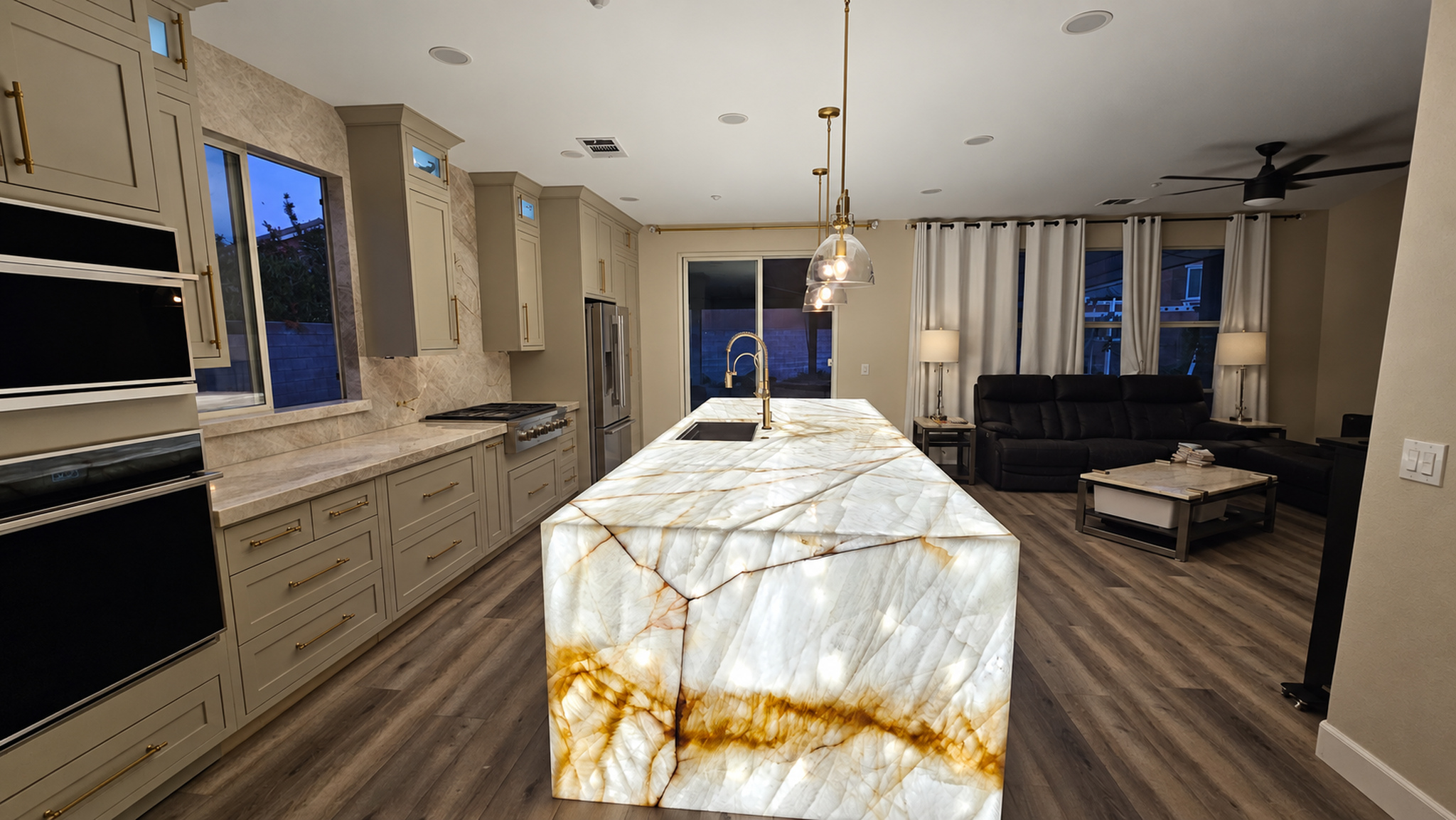
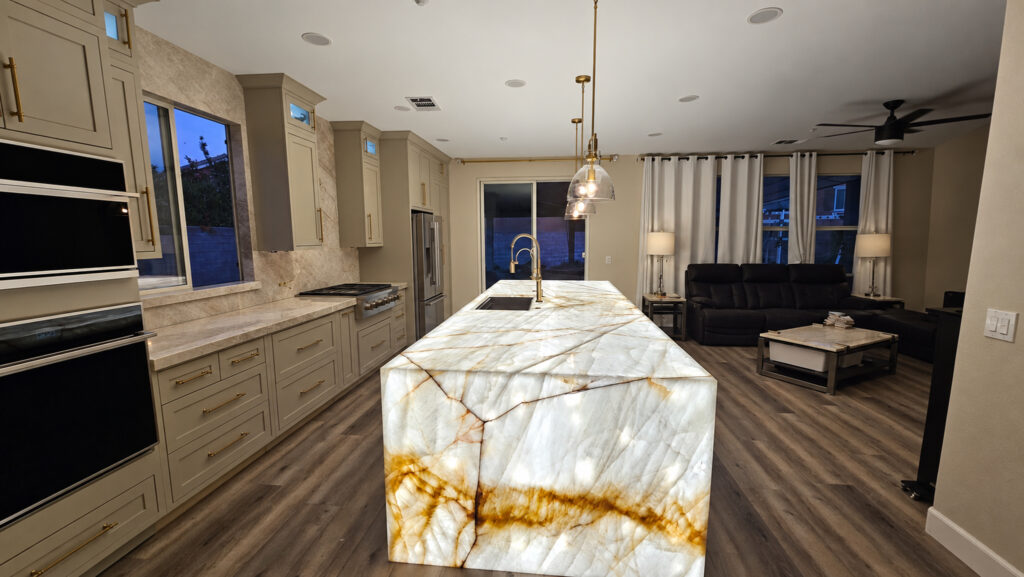
One of the most important questions in stone backlighting is: how much space should there be between an LED light panel and translucent stone?
The answer is not simply “half an inch.” Sometimes the stone can sit directly on the LED panel. In many countertop applications, a 1/2-inch clear acrylic spacer is the preferred solution. In vertical applications, an air gap can often provide the necessary separation without requiring a full sheet of acrylic.
The correct spacing depends on the stone, its translucency, the lighting system, the size of the illuminated surface, the number of LED panels underneath it, and whether the application is horizontal or vertical.
After more than 17 years specializing in architectural backlighting, one of the most important things we have learned is that the actual stone should ultimately determine the spacing.
Why Is Spacing Important When Backlighting Stone?
An LED light panel produces a controlled illuminated surface, but the stone above it becomes the final diffuser.
Some stones diffuse light extremely well. Others are so crystalline and translucent that they reveal almost everything behind them. This is particularly important with materials such as Cristallo Quartzite, Onyx, translucent marble, semi-precious stone, translucent engineered surfaces, and certain resins and solid-surface materials.
The more transparent or crystalline the material, the more likely it is to reveal differences underneath it, including panel seams, changes in brightness, structural components, or other elements behind the stone.
Creating additional distance between the light source and the stone gives the light more opportunity to blend before it reaches the finished surface.
More separation generally means more opportunity for the light to blend. However, that does not mean more spacing is always better. The objective is to use enough spacing to achieve even illumination without unnecessarily increasing the thickness of the assembly.
What Is the Recommended Spacing for Backlit Stone?
For many horizontal countertop applications using highly translucent stone, our starting recommendation is 1/2 inch of clear acrylic between the LED light panel and the stone.
A typical assembly would be:
Cabinetry or framework
1/2-inch plywood subtop
1/4-inch frameless LED light panel
1/2-inch clear acrylic spacer
Translucent stone
For materials such as Cristallo Quartzite, this has become one of our most commonly recommended configurations. The acrylic creates physical separation between the LED panel and stone while also providing a continuous support surface beneath the countertop.

Why Use Clear Acrylic Between the LED Panel and Stone?
The clear acrylic spacer is not another light source. Its primary purpose is to create distance between the illuminated LED panel and the underside of the stone.
That distance allows light from adjacent LED panels to blend before it reaches the stone. This becomes particularly important on large kitchen islands and countertops where several LED panels may be required.
For example, a 10-foot kitchen island may require multiple custom light panels rather than one enormous panel. Even when the individual panels illuminate evenly, there are still physical transitions between them. Placing extremely transparent stone directly against those transitions increases the possibility that the stone will reveal them.
Raising the stone approximately 1/2 inch above the panels provides additional blending distance. The clear acrylic also provides continuous physical support beneath the stone, making it particularly useful for horizontal applications.
Do You Always Need a 1/2-Inch Acrylic Spacer?
No. Stone backlighting should be treated as an application rather than a universal formula.
A stone with substantial veining, cloudiness, or natural diffusion may conceal the lighting system extremely well. In some cases, the stone can sit directly over the LED panel and still produce excellent results.
A very clear or crystalline slab may behave completely differently. Even two slabs carrying the same commercial stone name can transmit light differently because natural stone is not manufactured to an optical specification.
The better question is not simply, “Can stone sit directly on an LED panel?” It can. The important question is, “Does this particular stone diffuse the light sufficiently when placed directly over the panel?”
Why We Commonly Recommend 1/2 Inch for Cristallo Quartzite
Cristallo Quartzite is one of the materials where spacing becomes particularly important. Its crystalline structure is exactly what makes it spectacular when illuminated, but it can also make it less forgiving.
Some Cristallo slabs are relatively cloudy and naturally diffuse light. Others can be surprisingly transparent. With highly crystalline Cristallo, details underneath the stone can become visible once the slab is illuminated.
For horizontal Cristallo countertops and kitchen islands, 1/2-inch clear acrylic is therefore our typical starting recommendation. It provides a practical balance between light blending, overall assembly thickness, continuous stone support, and concealing transitions between individual LED panels.
Is 1/4 Inch of Spacing Enough?
Sometimes. A 1/4-inch clear acrylic spacer provides some separation and can be useful where the overall buildup needs to remain thin. However, it provides less blending distance than 1/2 inch.
For moderately translucent stone, 1/4 inch may be completely adequate. For very crystalline Cristallo or Onyx installed over several individual LED panels, we generally prefer 1/2 inch when the construction allows it.
Would a 3/4-Inch or 1-Inch Gap Work Better?
Additional spacing can provide more blending, but it is not automatically necessary. Once the illumination is already uniform, increasing the spacing further may simply create unnecessary construction depth.
The objective is sufficient separation, not maximum separation.

Horizontal and Vertical Stone Backlighting Are Different
This is an important distinction when designing a backlit stone installation.
For a horizontal countertop or kitchen island, the stone requires continuous structural support. This is one reason we commonly use a full clear acrylic spacer sheet.
The acrylic performs two functions: it creates the desired separation between the LED panel and stone, and it provides a continuous surface supporting the stone above.
A vertical stone wall, backsplash, or feature wall is different. The stone is supported by the vertical assembly, so there is generally no reason to install a full sheet of clear acrylic simply to create separation.
Instead, the stone can be positioned approximately 1/2 inch away from the LED panels, creating an air gap that gives the light room to blend before reaching the stone.
A typical vertical configuration is:
Wall or structural substrate
LED light panel
Approximately 1/2-inch air space
Translucent stone
Clear Acrylic vs. an Air Gap
From a practical backlighting standpoint, the objective is separation and light blending.
In a horizontal application, clear acrylic is extremely useful because the countertop requires support. In a vertical application, an air space can provide the separation without requiring an unnecessary acrylic support sheet.
This is why copying a countertop layering detail directly onto a feature wall—or vice versa—does not always make sense. The application determines the construction method.
Can Acrylic Strips Be Used Instead of a Full Sheet?
For horizontal stone, we generally prefer a continuous clear acrylic sheet.
Individual acrylic strips or a grid can physically create the required height, but they introduce additional acrylic edges beneath the illuminated stone. With highly translucent material, those edges can potentially become visible because of the way light refracts and reflects through acrylic, creating unwanted bright lines or patterns.
This does not mean strips will be visible through every slab. However, if the objective is the cleanest and most predictable illuminated surface possible, a full clear acrylic sheet eliminates that unnecessary variable.
What About Seams Between Multiple LED Light Panels?
Large countertops and kitchen islands frequently require more than one LED panel. This is completely normal.
Custom frameless LED panels can be manufactured in large sizes and unusual shapes, but there are practical considerations involving manufacturing, shipping, handling, sink locations, and installation.
The goal is not necessarily to manufacture one enormous LED panel. The goal is to use as few panels as reasonably practical and design the layering system so the finished stone appears as one continuously illuminated surface.
Spacing plays an important role. The farther the stone is positioned from the physical transition between two panels, the more opportunity the light has to blend before reaching the stone.

How Do You Know If Your Stone Needs More Spacing?
Test the actual stone whenever possible.
Before the countertop is fabricated, place a strong light source behind the slab and observe how the stone responds. Do not test only one location.
Move the light behind clear crystalline areas, heavy veins, cloudy sections, resin-filled areas, fissures, and different parts of the slab. Natural stone can vary dramatically across a single piece.
A section that appears almost opaque may sit only inches away from an area that transmits a tremendous amount of light. The more clearly you can identify the individual light source behind the stone, the more attention should be given to spacing and diffusion.
A Simple Test for Translucent Stone
A useful practical test is to place a flashlight or another concentrated light source behind the slab.
If the individual light source is extremely obvious through the stone, the slab is highly transparent and will probably benefit from additional separation.
If the light immediately spreads and becomes difficult to identify as an individual source, the stone itself is providing substantial diffusion.
This is not a laboratory measurement. It is simply a fast and useful way to understand how forgiving—or unforgiving—the material is likely to be when illuminated.
Does Stone Thickness Change the Required Spacing?
It can, but thickness is only one variable.
All else being equal, a thinner translucent material will generally allow more light through than a thicker version of the same material. However, a highly crystalline 3 cm slab can sometimes transmit more visible light than a cloudy 2 cm slab.
Veining, mineral composition, resin, mesh backing, reinforcement, and the natural structure of the material can all affect the finished result.
For this reason, spacer thickness should not be selected solely because the stone is 2 cm or 3 cm. The actual translucency of the slab matters more than nominal thickness alone.
What Causes Hotspots in Backlit Stone?
A hotspot is an area that appears noticeably brighter than the surrounding illuminated surface.
Potential causes include insufficient distance between the light source and stone, extremely transparent sections of the slab, inconsistent spacing, structural elements beneath the surface, transitions between lighting components, or natural differences within the stone itself.
The solution is not always to use brighter lights. Increasing brightness can sometimes make inconsistencies more noticeable.
Proper spacing, panel layout, and diffusion are generally more important than simply increasing LED output.
Can Dimming Help?
Yes, but dimming and spacing solve different problems.
Dimming controls the overall brightness of the installation. Spacing controls how effectively the light blends before reaching the stone.
A poorly diffused lighting system does not become properly diffused simply because it is dimmed. Once the layering and spacing are correct, however, dimming becomes extremely useful.
Translucent stone can become surprisingly bright, particularly in a residential environment at night. Reducing the output allows the stone to create a softer architectural glow rather than overpowering the surrounding space.
Operating LED systems below maximum output can also reduce heat and electrical stress on the LEDs and power supplies.

What Is the Best Layering for a Backlit Kitchen Island?
For highly translucent stone such as Cristallo Quartzite, our most commonly recommended horizontal configuration is:
Cabinetry
1/2-inch plywood subtop
1/4-inch custom frameless LED light panels
1/2-inch clear acrylic spacer
Stone countertop
This creates an overall lighting and spacer buildup of approximately 3/4 inch above the plywood, before the stone itself is added.
That dimension should be communicated to the cabinetmaker and stone fabricator before final fabrication.
Plan the Spacing Before the Stone Is Fabricated
Do not wait until the stone has been fabricated and the cabinets are complete before deciding how the lighting will fit underneath it.
The lighting assembly can affect finished countertop height, plywood subtop dimensions, mitered edge construction, sink and cooktop details, cabinet clearances, panel dimensions, wire routing, and power supply locations.
Backlighting is considerably easier when the cabinetmaker, stone fabricator, electrician, and lighting supplier are all working from the same layering dimensions.
How Much Space Should You Leave Between the LED Panel and Stone?
Moderately translucent stone:
Direct placement may work if testing confirms that the stone sufficiently conceals the lighting system.
Highly translucent horizontal stone:
Approximately 1/2 inch of clear acrylic spacing is a good starting point.
Extremely transparent material:
Additional spacing or diffusion may be required after testing the actual slab.
Vertical stone:
Approximately 1/2 inch of air space can often provide the necessary separation without requiring a full acrylic support sheet.
Large surfaces using multiple LED panels:
Spacing becomes increasingly important because it helps blend transitions between the individual panels.
The most important rule is simple: design the spacing around the actual stone—not just the name of the stone.
Frequently Asked Questions About LED Panel Spacing and Stone Backlighting
Do you need a gap between an LED panel and Cristallo Quartzite?
For highly crystalline Cristallo Quartzite, we typically recommend approximately 1/2 inch of separation between the LED panel and stone. In horizontal applications, this is commonly created using a 1/2-inch clear acrylic spacer.
Can Cristallo Quartzite sit directly on an LED light panel?
Yes, in some applications. If the slab has enough natural diffusion to conceal the lighting system beneath it, direct placement can work. Highly crystalline or transparent slabs are more likely to benefit from additional spacing.
What thickness acrylic should be used under a backlit stone countertop?
1/2-inch clear acrylic is our most common recommendation for highly translucent horizontal countertop applications. A 1/4-inch spacer can work in some installations, while unusually transparent materials may require additional separation.
Does a vertical backlit stone wall need a clear acrylic spacer?
Not necessarily. Unlike a countertop, a vertical stone installation does not require acrylic to continuously support the stone. An approximately 1/2-inch air gap can often provide the required light-blending distance.
Why can I see seams between LED panels through my stone?
The stone may be highly transparent, or there may not be enough separation between the LED panels and stone. Increasing the blending distance with a clear acrylic spacer can help reduce the visibility of panel transitions.
Should the acrylic spacer be clear or white?
For the spacing method discussed here, we generally use clear acrylic. A separate diffusion material may be used in unusually demanding applications, but it serves a different purpose from the structural clear acrylic spacer.
Is more spacing always better for stone backlighting?
No. Once the light is blending evenly, additional spacing may only increase the thickness of the assembly. The goal is sufficient separation, not maximum separation.
Need Help Designing a Backlit Stone Installation?
Every translucent stone project behaves differently.
Nu World Custom Lighting and Design has specialized in architectural backlighting for more than 17 years, including custom lighting systems for Cristallo Quartzite, Onyx, marble, translucent stone, glass, resins, and other architectural surfaces.
If you are planning a backlit kitchen island, countertop, bar, backsplash, or feature wall, send us the approximate dimensions, photographs of the stone, and any available drawings.
We can help determine the appropriate LED panel layout, spacing, layering, power requirements, and dimming configuration before fabrication begins.
Download the Nu World Backlighting Guide:
https://nu-wo.com/download-the-backlighting-guide/
View Featured Projects:
https://nu-wo.com/featured-projects/
Email: info@nu-wo.com
Phone: 1-604-900-2313